
FAQ
EcoEmber Incinerator: Frequently Asked Questions (FAQ)
1. General & Technology
What type of technology does the EcoEmber incinerator use?
A : It is an oxygen-enriched high-temperature incinerator featuring a two-stage combustion process. This design achieves a 95% reduction in waste volume and near‑zero emissions, making it suitable for decentralized waste management in urban and suburban areas.
What is the operating temperature range inside the furnace?
The temperature inside the furnace ranges from 850°C to 1200°C.
Does the system require waste segregation before feeding?
No. The system is designed to accept mixed Municipal Solid Waste (MSW) without prior segregation, thanks to its integrated pretreatment and combustion processes.
2. Operational Parameters
What is the daily processing capacity?
The system is rated for 10 tons per day (TPD) of municipal solid waste.
What is the operational schedule?
The machine runs 6 days per week, followed by a mandatory 1-day shutdown for maintenance, cooling, and inspection.
How many people are needed to operate it?
Only 6 personnel are needed to manage the entire operation per shift/cycle.
Does the system produce any liquid discharge?
No. The EcoEmber is designed for zero leachate discharge. Unlike landfills or conventional dumps. Leachate is thermally destroyed, and the flue gas treatment uses a closed‑loop, non‑contact cooling process that produces no secondary water pollution.
3. Infrastructure
What are the space requirements for this incinerator?
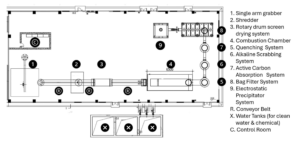
What utility are required?
The utilities required are :
1. Power Supply– Arrange a 300-amp power supply for the machinery. Ensure correct cable fixing, breaker and safety disconnect.
2. Water Supply– daily water consumption is approximately 1m3
4. Waste Pretreatment & Leachate Management
How is leachate handled?
The storage pit collects leachate, which is then extracted by a self‑priming pump and transported to the high‑temperature combustion chamber for thermal destruction. This creates a closed‑loop system with no leachate discharge to the environment.
What happens to inert materials like glass, ceramics, and stones?
After shredding and rotary drum screening, the heavy fraction (glass, ceramics, stones) is removed and sent to landfill. The light fraction (combustible waste) proceeds to combustion.
5. Feed System & Shredding
How is waste fed into the incinerator?
An automated, remote‑controlled single‑arm garbage grab (7.5 kW motor, 6‑meter rotating arm) picks waste from the storage pit, lifts, rotates, and dumps it into the feed chute. Each cycle takes 4 minutes, completing 7 grabs per hour (approx. 1.4 tons/hour).
Is metal recovered from the waste stream?
Yes. After shredding, a conveyor system with an integrated magnetic separator extracts ferrous metals for recycling.
6. Combustion Process
What are the main stages of combustion?
The process uses a two‑stage design:
- Main furnace– oxygen‑limited thermal decomposition (torrefaction & gasification) produces combustible gases and 5‑10% ash.
- Secondary combustion chamber– high‑temperature complete oxidation of gases, destroying organic pollutants like dioxins and furans.
Does the system need external fuel after startup?
No. It is energy self‑sufficient – the waste’s own calorific value maintains autothermal operation. Only cold startup requires an external flame (firewood or diesel) to reach ~600°C before waste feeding.
How does the system prevent clumping or coking of waste?
A heat‑tolerant rotating grate at the furnace base constantly agitates the burning waste. Combined with a staged air supply and a wider bottom geometry, this ensures even burning and prevents solid mass formation.
Is there heat recovery?
No. The flue gas volume and heat value are considered too low for economic/technical heat recovery.
7. Flue Gas Treatment & Emissions
What emission control systems are installed?
An integrated multi‑stage system:
Rapid cooling (quench tower) → Cyclone dust removal → Deacidification & demisting → Activated carbon injection → Baghouse filtration.
How are dioxins controlled?
The quench tower rapidly cools flue gas from 1100°C to below 250°C in ~3 seconds, preventing dioxin formation in the critical 250–500°C range. Any residual dioxins are adsorbed by activated carbon and captured in the bag filter.
How is SO₂ removed?
A collision‑type water mist swirl spray system atomizes alkaline absorbent into fine droplets (0.5–2 mm), achieving >200% coverage and high desulfurization efficiency. A horizontal mist eliminator removes slurry droplets.
What is the final particulate removal efficiency?
The baghouse filter captures particles down to 0.05 μm with >99% efficiency. Filter bags are made of high‑temperature, acid‑resistant, hydrolysis‑resistant material
8. Ash & Byproducts
What happens to the ash?
Bottom ash collects in a hopper and is treated as general industrial waste. The document notes that ash can be reused in construction (e.g., lightweight bricks) – supporting a circular economy.
How is fly ash managed?
Fly ash containing stabilized toxic substances is safely collected from the bag filter and landfilled
9. Economic & Social Benefits
What cost savings does EcoEmber offer?
The cost saving are as follows:
- Eliminates waste transport costs to centralized facilities.
- No fuel costs after initial ignition (only diesel for cold startup).
- Low maintenance due to self‑cleaning combustion chambers.
How does it benefit local communities?
The benefits are :
- Reduces landfill‑related pollution and health risks.
- Mitigates NIMBYopposition because of clean, near‑odorless operation.
- Supports decentralized waste management in both rural and urban areas.
10. Suitability & Feedback
Who is the EcoEmber incinerator best suited for?
Municipalities, industries, and communities seeking a zero‑waste, low‑carbon alternative to landfills and conventional incineration. Its modular, self‑sustaining design is ideal for decentralized waste management.